The decision comes at a time when macroeconomic conditions in Ghana have shown notable improvement.
Ghana’s MPC Cuts Policy Rate to 15.5%: What It Means for You
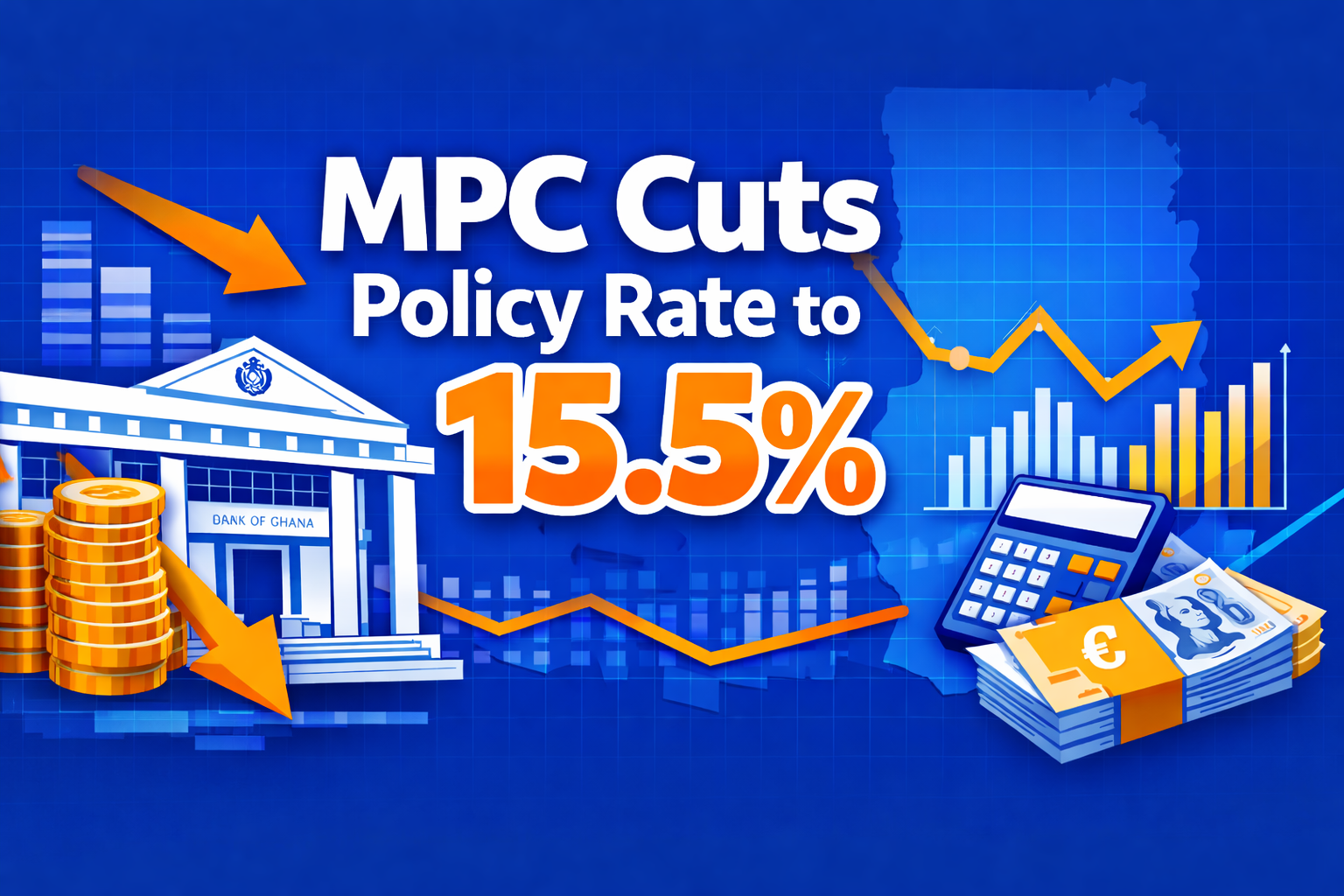
On January 28, 2026, the Bank of Ghana’s Monetary Policy Committee (MPC) announced a significant cut in the country’s benchmark interest rate. The Monetary Policy Rate (MPR) was lowered by 250 basis points to 15.50%. This move marked the first MPC decision of the year and the lowest policy rate in four years.
The decision comes at a time when macroeconomic conditions in Ghana have shown notable improvement. Inflation has eased dramatically, the economy is growing at a respectable pace, and financial conditions are gradually improving. But what does this mean for you? For the trader, the saver, the business owner, or the professional thinking about taking a loan? This piece breaks it down in everyday language, explains the logic behind the decision, and points to what we should watch next.
The Basics: What Is the Monetary Policy Rate?
The Monetary Policy Rate, or MPR, is a tool the Bank of Ghana uses to influence the cost of money in the economy. When the MPC raises the policy rate, it becomes more expensive for banks to borrow money from the central bank. Banks often pass that cost on to customers through higher lending and borrowing rates. When the MPC cuts the policy rate, the opposite is supposed to happen: borrowing becomes cheaper, and lending rates may fall.
For most people, the policy rate influences:
- Interest rates on loans and mortgages
- Returns on savings and fixed deposit
- The pace of business investment
- Inflation and general price stability
So when the MPC cuts the policy rate, the goal is usually to encourage borrowing and investment, support growth, and reduce the cost of credit.
Why Did the MPC Reduce the Rate?
There are three main reasons the Committee took this step:
1. Inflation Has Fallen Sharply
Inflation in Ghana has dropped much faster than many expected. In December 2025, headline inflation was just 5.4%, down from 23.8% a year earlier. This is a dramatic change, and it places Ghana close to the Bank’s medium-term inflation target of 8% ± 2%.
Lower inflation means that the prices of everyday goods and services are rising more slowly. When inflation is high, money loses value quickly — and lenders charge higher interest rates to protect themselves. When inflation comes down and stays under control, there is room for the central bank to ease monetary policy.
2. The Economy Is Growing at a Healthy Clip
Data from the Ghana Statistical Service shows that Ghana’s real GDP grew by about 6.1% in the first three quarters of 2025. Growth was supported by stronger performances in services and agriculture, sectors where many Ghanaians work.
A growing economy makes it easier for households and businesses to take on credit, invest, and spend money. The MPC saw this growth as a signal that policy could shift away from crisis mode toward one that supports sustainable expansion.
3. Other Macro Indicators Have Improved
The cedi has strengthened against major currencies, foreign exchange reserves have risen, and the fiscal deficit has narrowed significantly. Public debt levels have also come down as a share of GDP.
These factors help the central bank feel more confident that inflation pressures are under control and that the economy can handle a lower policy rate without reigniting inflation.
What This Rate Cut Does (And Doesn’t Do)
Borrowing Costs Should Become More Affordable
A lower monetary policy rate should eventually lead to lower lending rates from banks and financial institutions. We are already seeing signs of that. Some commercial banks are actively reaching out to offer loans, a shift from recent years when credit was expensive and hard to get.
If borrowing costs come down, that could mean:
- Cheaper loans for small businesses
- Lower interest on mortgages
- More affordable credit for consumer purchases
This can help expand business activity, support home purchases, and stimulate private sector growth.
Savings Returns Could Stay Lower
While lower interest rates can help borrowers, they can also mean lower returns for savers. If you keep money in a fixed deposit or similar savings product, your interest earnings may be lower than before. That can be frustrating for people trying to save for long-term goals like education or home improvements.
Many Ghanaians already know this from experience: fixed deposit rates usually lag behind government Treasury yields, and when policy rates fall, banks adjust their savings rates accordingly. So while borrowing might get cheaper, your savings could earn less.
Inflation Is Not Gone Forever
The rate cut reflects confidence that inflation will stay within target, but risks remain. Utility tariff changes, commodity price fluctuations, and foreign exchange volatility could push prices up again. The MPC has emphasised it will continue to monitor conditions closely and adjust policy as needed.
That means the central bank is not committing to a long series of cuts regardless of what happens. If inflation starts rising again, the MPC could hold rates steady or even raise them to protect price stability.
What This Means for Everyday Ghanaians
Let’s break down the implications for different groups:
For Borrowers and Businesses
Lower policy rates should translate to lower interest rates on loans over time. For entrepreneurs and business owners, that means cheaper credit to invest in equipment, hire staff, or expand operations.
Small businesses that struggled with high loan costs over the past few years might now find it easier to access credit. That could help businesses grow, hire more workers, and contribute to economic activity across the country.
For Ordinary Workers and Families
If lenders pass on the rate cuts, smaller loans for things like home improvements, school fees, or vehicles may become more affordable. That means more families might consider formal credit rather than relying on informal lending with higher costs.
Lower inflation also helps families. If prices of food, fuel, and utilities rise slowly, your income goes further. For many middle-income Ghanaians, even a small reduction in price pressure can mean more predictable budgeting.
For Savers and Retirees
Savers need to adjust expectations. If banks reduce the interest they pay on savings accounts and fixed deposits, the real return on saving money might shrink. That can make long-term saving goals harder to meet.
If you are saving for education, a new home, or retirement, consult with your bank or a financial planner to explore alternatives that protect purchasing power without taking on too much risk.
For Investors
Lower lending rates and a stable macroeconomic environment make Ghana more attractive for investment. In particular, lower cost of capital can stimulate sectors like manufacturing, housing, and agribusiness.
However, investors must still watch inflation risk, global rate trends, and currency movements. If the cedi weakens, foreign denominated costs can rise, impacting returns. The MPC’s cautious approach reflects an awareness of these risks.
Putting It in Context: A Recent Journey
To understand how far Ghana has come, it helps to look back at last year’s rate cuts:
- In July 2025, the MPC cut the policy rate from 28% to 25%, reflecting early signs of disinflation and growth momentum.
- Later in September 2025, the rate was trimmed from 25% to 21.5% as inflation continued to ease.
- In November 2025, another cut brought it down to 18%.
- Now, in January 2026, it stands at 15.5%, after cumulative reductions of nearly 12.5 percentage points since mid-2025.
This rapid easing cycle is a sign that the central bank believes the economy is stabilising and that inflationary forces are under control. For everyday Ghanaians, that can create a more predictable economic environment — but it also places responsibility on households and businesses to plan carefully in a lower-rate world.
Why the Bank Is Being Cautious
Even with inflation down, the MPC’s approach is measured. The committee has emphasised that monetary conditions are still relatively tight relative to inflation and that the bank will monitor developments closely.
That means the rate cut is not a license for reckless borrowing or unchecked spending. It is an invitation for the economy to grow at a sustainable pace, for credit markets to open up responsibly, and for businesses to invest without fear of runaway prices.
Watch Points: What Comes Next
As citizens and professionals, here are key things to watch:
- How quickly banks pass on the rate cut to borrowers
If commercial banks hold onto high lending rates, the MPC’s intention won’t reach the real economy. - Inflation trends in the next few months
Keep an eye on food and energy prices. If they start rising again, inflation could bounce back. - Currency movements
A stable or strengthening cedi helps keep imported prices down and supports inflation control. - Credit growth in the private sector
Rising private sector credit indicates that businesses and households are responding to lower lending costs. - Fiscal discipline
Continued government focus on spending and deficits helps sustain confidence and allows monetary policy to be more effective.
Final Thoughts
The MPC’s decision to cut the policy rate to 15.5% is good news for many Ghanaians. It reflects progress in controlling inflation, stabilising prices, and supporting a growing economy. But it is not a magic bullet.
As with most economic policies, the benefits will depend on how fast the banking sector passes on the cuts, how households and businesses respond, and how external economic conditions evolve. It offers opportunities for cheaper borrowing and stronger growth, but also calls for careful financial planning from families and investors alike.
For you, that means understanding not just what changed, but why it changed — and how you can make informed decisions about borrowing, saving, and investing in this new monetary environment.

Subscribe to MDBrief
Clean insights, a bit of sarcasm, and zero boring headlines.